History and Introduction of the Exhibition |
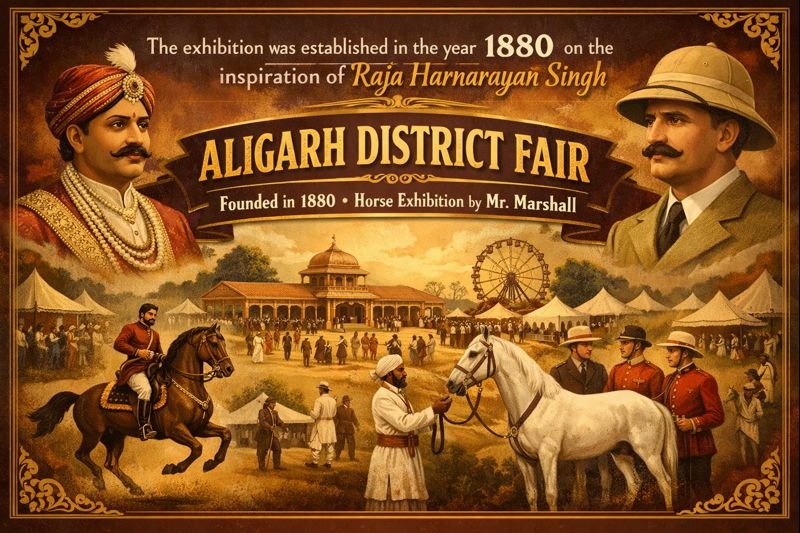
The exhibition was established in the year 1880 on the inspiration of Raja Harnarayan Singh, under the name Aligarh District Fair, and was initially organized as a Horse Exhibition by the then District Collector Mr. Marshall.
At the exhibition ground, the District Collector used to hold a Darbar (official court) where issues related to various departments of the district were discussed and resolved. He also guided his subordinates to ensure better administrative coordination.
In 1914, the then District Collector Mr. W. S. Marris, after whom Marris Road of Aligarh is named, constructed the Darbar Hall. At that time, the exhibition was organized once a year, during which three Darbars were held. This structure has now evolved into the present form of an Inaugural Ceremony and a Closing Ceremony.
Before India gained independence, apart from this horse exhibition and general Darbar, annual Darbars were also held in summer and winter. Gradually, the nature of these gatherings expanded. Cultural programs, sports activities, and entertainments were introduced, and prominent businessmen, successful professionals, wealthy citizens, and rural landlords began to participate.
On such occasions, affluent people displayed magnificent horses to the officials and organized horse-riding events as a symbol of social bonding and prestige. For these large gatherings, special confectioners were invited to prepare a variety of traditional delicacies.
Significant contributions were made to give this exhibition its grand and magnificent form by the District Collectors posted in the district from 1914 to 2008.
During this period, officers such as Mr. W. S. Marris, Mr. Gobind Narayan, Mr. K. C. Mittal, Mr. Dilip Kumar Bhattacharya, Mr. Somnath Pandita, Mr. S. D. Bagla, Mr. Santosh Yadav, Mr. Bhuvnesh Kumar, and others carried out various developmental works for the exhibition.
These works primarily included the construction of the Darbar Hall, the establishment of the main entrance of the exhibition known as Mittal Gate, the installation of the statue of the Father of the Nation, Mahatma Gandhi, at the main intersection of the exhibition grounds, the development of the Agriculture and Craft Village Market, the construction of the Open-Air Theatre, and the establishment of the Krishnanjali Drama Theatre.
The Grandeur and Cultural Significance of the Aligarh Exhibition
The exhibition, held once every year, has evolved into a unique center of trade, publicity, exhibition, and high-quality entertainment, not only for the Aligarh Division but also for people across the country.
This historic exhibition of Aligarh has now become the most prestigious exhibition in the districts of Western Uttar Pradesh, attracting an overwhelming number of visitors from the entire region.
Apart from essential household goods, the exhibition offers a wide range of products — from blankets, Kashmiri shawls, sarees, televisions, bicycles, to even needles. The cross-shaped market streets of the exhibition create a special charm that instantly attracts customers.
Each day, the exhibition appears in three different forms —
first as a purely rural fair, second as a modern urban marketplace, and third as a vibrant venue of youth engagement and cultural entertainment.
The Government Industrial and Agricultural Exhibition, Aligarh, located in the Banna Devi area of Aligarh district, is organized over approximately 17.250 hectares (1,72,500 square meters) of land.
The exhibition site lies at a latitude of 54 and longitude of 42, and according to a survey conducted in 1893, its elevation is about 611.867 feet above sea level.
During the British period, for security purposes, four companies of the 9th Regiment of the British Army were deployed at the exhibition ground. In later years, the British administration also began holding its official royal court (Darbar) in the Darbar Hall by setting up camps and tents there.
India truly resides in its villages, and their development and upliftment are essential responsibilities of governance and administration. In this context, it becomes vital to provide visitors with timely information regarding every department and subject that affects their lives.
The Agriculture and Development Section of the exhibition represents a sincere administrative effort to ensure that visitors receive complete developmental information and that the activities of every department remain transparent and accessible to the public.
The Industry Section of the exhibition has also proven highly beneficial. Renowned manufacturers display and sell the finest products produced in the district, allowing visitors to directly benefit from quality goods and industrial innovation.
Aligarh’s cultural identity remains incomplete without mention of the Aligarh Muslim University (AMU). The university holds a distinguished place in the cultural life of the district, and its influence is clearly reflected in the exhibition. Students of AMU actively participate and present cultural programs during the event.
The Aligarh Exhibition represents not only the district but the entire nation. Visitors from Kashmir to Kanyakumari, belonging to every religion and community, participate in the exhibition and proudly showcase India’s unity in diversity.
The exhibition enjoys nationwide recognition, attracting renowned traders, entertainers, and performers from across India, including Jammu & Kashmir, Haryana, Rajasthan, Himachal Pradesh, Karnataka, and many other states, thereby enriching the splendor of the exhibition.